
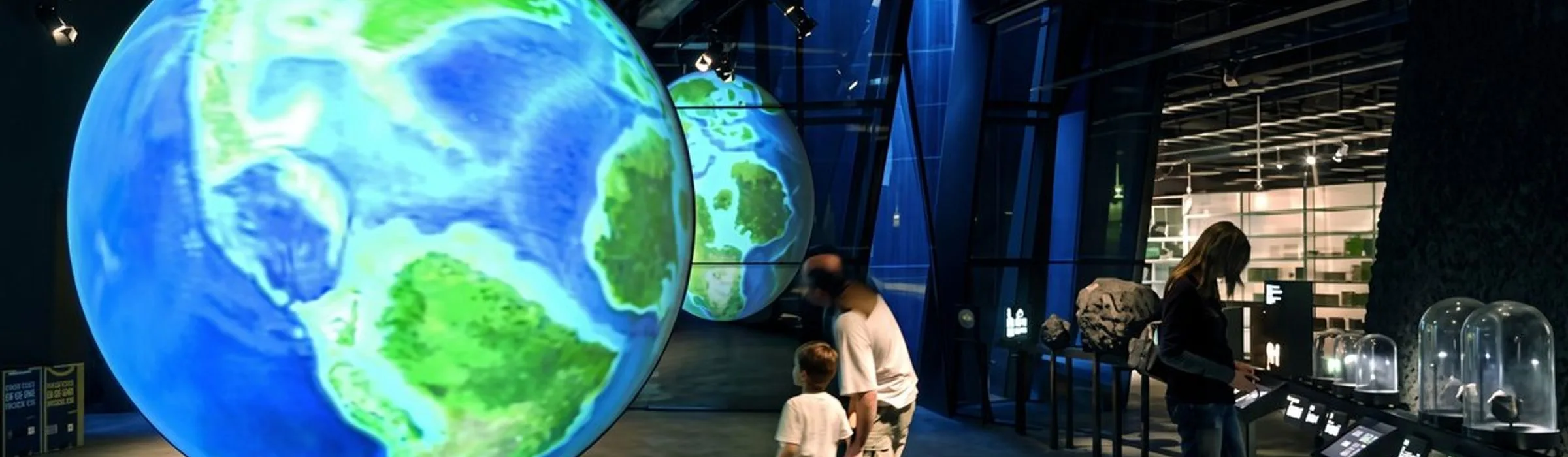
An exhibition exploring time through its origins, measurement systems, and how humans perceive it. Interactive displays and reflective installations invite visitors to think about how we experience time and how science keeps it.

Museums, screenings, shows and workshops that work without Spanish or Catalan, from original-version cinema to venues with English signage and staff who switch as soon as you ask.
An exhibition exploring time through its origins, measurement systems, and how humans perceive it. Interactive displays and reflective installations invite visitors to think about how we experience time and how science keeps it.
Cirque du Soleil's KURIOS presents acrobatics, live music, and visual theater under the Big Top. The production follows an inventor who discovers an invisible world of impossible machines, mechanical objects, and eccentric characters. The show blends contemporary circus with steampunk aesthetics, featuring precision acrobatics, elaborate costumes, and scenes designed to challenge perception.
Peter Parker is an adult now, alone, having wiped himself from the memories of everyone he loved to keep them safe. He fights crime in a New York that no longer knows his name, and the strain triggers a physical change that puts him in danger. Destin Daniel Cretton directs, with Tom Holland and Zendaya back alongside Mark Ruffalo. Its darker turn makes it one for older kids.
Wile E. Coyote has been flattened by ACME gadgets for decades, so he hires an unlucky lawyer and sues the company. It turns personal when the lawyer finds his old boss running ACME. Dave Green directs, putting the cartoon Coyote alongside Will Forte, John Cena and Lana Condor. The slapstick timing lands best in the original English, and parents raised on the Road Runner laugh as much as the kids.
The Halloween side of PortAventura Park is gentle for younger kids: Sesame Street shows, Truco o Trato (a walk-through with friendly ghosts that ends in candy), a soap-bubble show and an evening lake show with fire and fountains.
Admission covers the whole park and the haunted passages cost extra, so it works best as a full day.
On their last night together, best friends Jo and Raissa find a portal to Nakali, an island full of creatures from Philippine mythology. Getting home means facing the fearsome Manananggal, and the way back will cost them their shared memories. Joel Crawford, who made Puss in Boots: The Last Wish, directs with Januel Mercado, with Dave Franco, Jenny Slate and Manny Jacinto among the voices.
Oktoberfest Barcelona has moved indoors this year, to a climate-controlled pavilion at Fira Gran Via: long shared tables, a stage, Paulaner on tap, and food from bratwurst and pork knuckle to pretzels and strudel.
Kids are welcome with a parent, and strollers are fine, but it is a big loud beer hall, not an event built for children. Weekend lunchtimes are the family slot: food, oompah and room to move.
Paradox Museum turns its optical illusions, upside-down rooms and hands-on exhibits into a Castaween scavenger hunt. Kids look for six hidden Castaween characters between the illusions, and finding them all earns a prize. The hunt is an optional add-on, so the museum works just as well without it.
Festa Major de Sarrià honors the Virgin of the Rosary with decorated façades, giants parades, human towers, and sardanes. The program includes the Correfoc, a pyrotechnic spectacle where devils parade through streets with fire effects, alongside traditional Catalan performances and street activities rooted in neighborhood traditions.
Patis Oberts opens school playgrounds to everyone outside class time, so the yard down the street becomes a neighborhood play space. A monitor opens the gate, watches over the space and gets kids playing together.
The 20 city nursery schools in the program set out sandboxes and toddler play areas for the under-sixes, and several host a storytime during the season.
Sarrià's festa comes with its own funfair: bumper cars, trampolines, a roller coaster small kids can ride, game booths and food stalls. No Ferris wheel.
The rides stay on for six days after the festa ends.
Two street clowns arrive with a life raft, ready for the great flood. While they wait, their opposite personalities, fears and grief surface, alongside friendship and a lot of physical comedy. Nobody speaks, so it needs no Catalan or English. The show won Best Premiere at Fira Tàrrega in 2025.
David el Mag brings VIBRA to L'Autèntica Teatre as part of Vila Màgica 2026. The 60-minute family magic show mixes illusions, surprises, humor, and visual moments in a close, dynamic performance designed to keep children watching and reacting.
Three city kids move to a run-down farm and find an enormous tree in the woods. At the top, a new magic land arrives every day, and Silky the fairy, Moon-Face and the Saucepan Man are waiting. Ben Gregor directs Enid Blyton's classic, with Andrew Garfield and Claire Foy as the parents and Nicola Coughlan as Silky. Parents who grew up on the books will enjoy it too.
The Sitges fantasy and horror film festival has made room for kids since 2023. At the Mercat Vell, the Sitges Family program shows films, cartoons and shorts picked for children and teens, with the audience on giant beanbags.
The other big draw is the Zombie Walk, a crowd in full zombie makeup shuffling through town. Free makeup stations turn kids into the undead earlier in the day.
A drop-in learning space with reference books, games and experimental materials for discovering architecture. An educator helps kids explore, play and learn with hands-on resources. It's part of the program for Barcelona 2026 World Capital of Architecture.
Catalunya en Miniatura is an outdoor park in Torrelles de Llobregat filled with scale models of the Sagrada Família, Montserrat and other Catalan landmarks. For Halloween, costumed characters hide around the models to give families a small scare.
The frights are mild, which makes it a good pick for younger kids who find bigger Halloween events too much.
Every autumn the old amusement park on top of Tibidabo dresses up for Halloween. The moment kids remember is nightfall, when a new zombie show called The Last Dance (L'Últim Ball) takes over the Plaça dels Somnis, with a dance number that nods to the King of Pop.
Between rides, younger kids can look for the park mascots Ti, Bi, Da and Bo in their Halloween outfits.
The Castanyera is the chestnut seller who turns up in Catalonia every autumn. For this workshop she has filled La Pedrera with autumn objects, and kids solve challenges in the building's best-known spaces to find them, seeing Gaudí's house up close along the way.
It runs in Catalan, so it suits kids who follow Catalan at school and gives them a nice chance to use it somewhere new.
Brickània is Montblanc's LEGO festival, inside the medieval church of Sant Francesc and its cloister. Kids walk around eight big dioramas, from Harry Potter's world to a medieval Montblanc, and the apse holds three built around the town's Sant Jordi legend. Then they can build at the play area, join a short robotics session, or browse stalls of new and secondhand sets. It suits kids who already build at home.
Món Sant Benet is a medieval monastery in the Bages countryside. Its Castanyada story is about an old chestnut seller who put a spell on her recipe book, so the ingredients now read like troll nails, giant dandruff and bat blood.
Kids follow the clues to decode the recipe, then turn it into a panellet, the small almond sweet of the season. It is spooky in a silly way.
Vila Màgica is Gràcia's own magic festival, now in its third year and run by neighborhood associations. For families, the heart of it is the open-air stage in Plaça Joanic: a comedy magician, rows of folding chairs and a crowd of kids. The acts are built on humor and audience participation, so expect volunteers to be called up. Indoor shows around the neighborhood fill out the rest of the program.
Petit Vivaldi is a puppet and live music show featuring actress and puppeteer Mar Gascó and musician Pere Picanyol performing Vivaldi's Four Seasons. The production uses handmade puppets, traditional songs, and animal stories to introduce classical music to infants and toddlers, with live arrangements and lighting design accompanying each seasonal narrative.
A family rock concert with a real band on stage. Big Mouthers, a Catalan covers band, plays AC/DC, Queen, Ramones and Green Day, plus Spanish rock from Fito, Barricada and Loquillo. Between songs, Rosendo the bear and a cast of puppets tell funny stories about the bands, and there are games and surprises along the way.
Two neighboring festes majors end on the holiday, both with a family program. Sarrià starts with its homemade cart race down the old main street and closes with an outdoor movie and a cold-fire show. Les Corts fills the afternoon with a magician, the giants' farewell dance and a correfoc, then ends with fireworks set to music. Do a morning in one, an evening in the other.
Workshops for parents who want to understand why their kids behave the way they do, and respond with empathy and confidence instead of frustration. Certified parent coach Fabiana of Growing Together Parenting leads each one. Every session takes a single topic, from a new sibling's arrival to setting boundaries without power struggles, so you can join one or several. Babies are welcome.
Kids spend the night beside the tanks, surrounded by sharks, rays, moray eels and other species, and learn what sharks are like, how they breed and what they do after dark. The night includes a guided tour of the main exhibits, a game called Shark Investigators, and a tour of the aquarium's technical area. Civil liability insurance is included.
Every autumn the Castanyera comes down from the mountain to roast chestnuts in the city square. This year the kids only want Halloween costumes and candy, so she decides it's time to reinvent herself, and not every idea goes to plan.
It's a gentle way into the two traditions that share October 31. Costumed characters, including a pumpkin-headed Jack, help kids still learning Catalan follow along.
Granja Aventura Park is a farm and outdoor adventure park. For Halloween it adds spider webs, a pretend cemetery, and friendly witches, vampires and chestnut sellers in costume.
The spooky touches lean silly rather than scary, and the same ticket covers the farm animals and the adventure circuits in the trees. Nearly everything is outdoors, so bring shoes that can get muddy.
Rebecca June's Peace is Possible! is a handbook, not a lecture: seven ideas, one per color of the rainbow, drawn by Émilie Gleason as a crowd of odd, cheerful characters.
The workshop takes it off the page. Kids start with the fights they know, whose turn it is, the sibling who will not leave, then work through the themes by talking and making things.
A family Halloween spread through the streets of Poble Espanyol: 30 costumed characters, two walk-through tunnels, magician acts, games, a scavenger hunt and food trucks. Kids follow clues and solve riddles as they go, and costumes are welcome.
Kids build stone arches the way medieval masons did, inside the Royal Shipyards that house the Maritime Museum. Then they carve their own stonemason's mark in clay and take it home. The workshop is part of the museum's Drassanes Reials program for Barcelona's 2026 year as World Capital of Architecture.
Families explore the Barcelona Shipyards' construction techniques by building stone arches using ancient methods, then create personalized stonemason marks from clay to take home. Part of the "Royal Shipyards: stones that tell Barcelona" program developed for Barcelona's UNESCO-UIA World Capital of Architecture 2026 designation.
Every two years Cornellà turns into a clown town. The International Clown Festival, formally the Memorial Charlie Rivel after the Catalan clown who took his act around the world, has run since 1984. Its 70 performances of 44 shows fill streets, squares, markets, theaters and a circus tent.
The one to book is the Gala Alapista!, a variety show with clowns and acrobats from Catalonia, France, Canada and Brazil.
Civic centers, libraries and neighborhood casals all over Barcelona throw small parties for the Castanyada, and many mix in a little Halloween too. Think roasted chestnuts, the Castanyera in her headscarf telling stories, puppet shows and face painting.
These are the neighborhood's own parties, small and friendly. Kids roll panellets, walk through a homemade spooky tunnel, or just eat warm chestnuts with friends.
Late October is harvest time in the towns inland from Barcelona. In the Montseny the fair is all about chestnuts, roasted over open fires, and guides lead walks through centuries-old groves. Out on the plains, farmers weigh their biggest pumpkins and kids paint small ones to take home.
Other towns retell their witch legends, with whole villages dressing up for puppets, street theater, music and fire.
Masia Vilanoveta, a country house just outside Sitges, turns its grounds into a pumpkin field each fall. Kids walk the rows looking for the one that feels like theirs, then paint and decorate it at the craft tables.
It feels more like a village autumn fair than a ticketed attraction, with food, stalls, a stage, games and bouncy castles. Plan a slow afternoon, not a quick stop.
Castaween is the Museu de la Xocolata's mix of the Castanyada and Halloween. In its family workshops, kids and parents work side by side, piping melted chocolate into spiderwebs, witch hats and pumpkin faces, or decorating butter cookies with ghosts and bats.
One workshop, Xoco Trencadís, adds a bit of Barcelona history: kids build a broken-tile mosaic, the style Gaudí made famous, out of colored chocolate.
More than 1,200 drones lift off over Parc del Fòrum and redraw the night sky into Hogwarts castle, a snowy owl and other moments from the Harry Potter films, while a live electric violinist plays the film themes from the stage below. The drones fly during a select number of songs, and the violinist carries the rest of the hour. It is an open-air, seated show that runs about 60 minutes with an intermission, and it lands in Barcelona for two nights only, Friday October 23 and Saturday October 24, 2026. Gates open at 7pm, two hours before the 9pm start, with food and drink stands inside, so the wait can double as dinner. Seats are not assigned, so the earlier you arrive, the better your view of the stage.
For one weekend a year, buildings that are normally closed open their doors: 155 in Barcelona, plus more in five nearby towns. Volunteers run every door, and at some, the architect who designed the space shows you around. Kids get to walk into places they would never see otherwise.
It suits curious kids who can handle a short queue. Toddlers will find it a lot of walking.
El Mago Pop's new show, "Nada es Imposible," is a large-scale illusion show with brand-new tricks and acts never seen on stage before, set to music and big theater staging. Over 3 million people have seen his shows in Barcelona, Madrid and on Broadway.
Street trick-or-treat routes can be a lot for a one-year-old. Kids&Kafé, a play cafe in Les Corts, runs small Halloween sessions sized for the youngest ones instead.
Expect Halloween games, a photobooth and a snack, with one grown-up joining each child. One morning is given over to decorating monster cookies.
A two-actor mystery play staged outdoors for the Navas neighborhood's Castanyada party. One rainy night, two young detectives spot something moving in a garden tree, and the audience helps them work out what it is.
It's a small local party, not a big city event.
Shopkeepers in neighborhoods all over Barcelona turn their streets into trick-or-treat routes for Halloween and the Castanyada. Kids in costume go from shop to shop, look for the sign in the window, and ask for candy.
The map shows every route found, each with its time. Some still show last year's times, since most shop associations post theirs in mid-October.
Kids in costume go from shop to shop through Barceloneta asking for candy, handed out by the storekeepers themselves. The shopkeepers' association puts it on with the neighborhood's school parent groups and local festival committee.
Every fall, roasted chestnut stands pop up on street corners all over Barcelona. A warm paper cone of chestnuts, or a roasted sweet potato, on the walk home is the easiest way to do the Castanyada with kids.
The pins show the 2025 stands, because the 2026 list is not out yet. The city usually posts it in late October, and most stands return to the same corner.
Plaça Monumental is Barcelona's old bullring, and on Halloween its open ring turns into a party for kids. There are craft workshops, face painting, clowns, and DJ sets with a kids' show.
Food trucks are on site, so lunch can be part of the day, and it is an easy plan to pair with trick-or-treating later in the evening.
A street party put on by the neighborhood's shopkeepers for the Castanyada and Halloween. Shops and restaurants set up stalls along the street, local groups run activities, and last year there was music, dancing, workshops, face painting and roasted chestnuts.
Older kids come for the passatge del terror, a real haunted passage. With little ones, come early for the stalls, and head home before the late band.
Joan's parents have an unusual worry: their son has never been scared of anything. So they book a weekend in a haunted house, hoping the ghosts, monsters and curses will finally teach him what fear feels like.
What follows is a comic musical in Catalan from La Roda Produccions, full of songs, dance numbers and spooky characters who can't quite rattle him. The scares are played for laughs.
Barcelona's children's film festival screens around 100 international films across 21 showings, with a children's jury judging alongside adults. Workshops accompany select screenings, offering hands-on cinema experiences in a real festival setting.
This version of the classic Christmas ballet keeps Tchaikovsky's famous melodies but hands them to a live jazz band, so kids hear tunes they may already know played as jazz.
Instead of tutus, a big cast of dancers in bright, playful costumes tells the story through contemporary dance. It plays in the Liceu's main hall, so it doubles as a first look inside Barcelona's grand red-and-gold opera house.
Barcelona's board game festival has hundreds of games to sit down and play, split into themed areas: Dauet for younger kids, giant games, traditional Catalan games, role-playing, a calm corner and tables of unreleased titles.
Volunteers and publishers teach the rules at the tables.
elPetit, now in its 22nd edition, is a festival of live shows, workshops and art installations made for babies and preschoolers. Catalan and international companies perform for small audiences, and most shows rely on movement, music and objects with few or no words.
Els Llums de Sant Pau is a night walk through the Recinte Modernista de Sant Pau, a former hospital of tiled domes and red-brick pavilions, lit up for Christmas.
For 2026 the trail follows The Little Prince, with projections on the old stone, live characters, interactive stops, and an explorer's passport with hidden stamps for kids to collect. A small ice rink sits along the route.
Caga Tió is the Catalan Christmas log: kids feed it all December, then beat it with sticks, singing, so it will "poop" out sweets.
Civic centers and neighborhood casals throw their own tió parties, with a big shared log, songs and stories. Some add a twist: a flashlight hunt for the tió in the Collserola woods, or a workshop where kids decorate a log to take home.
Every Christmas the old harbor turns into a waterfront fair: wooden stalls and lights along Moll de la Fusta, a 65-meter Ferris wheel turning over the boats, and a synthetic ice rink.
What sets it apart from the city's other fairs is the sea. Historic ships open their decks, and younger kids head for the old-fashioned carousel and the Christmas train, with Santa waving from the front car.
Winterland turns Casa Balcells, a century-old country estate in La Garriga, into a Christmas world you walk through in stages: Santa's house with its toy factory and candy kitchen, a themed garden, the Three Kings' kingdom and an enchanted forest, with actors in character all along the way.
For kids who believe, the big draw is meeting both Santa and the Three Kings in one visit.
Sant Andreu's year-end festival fills the streets of Sant Andreu de Palomar with fire runs, traditional Catalan music, and giant parades. The district's major celebration closes Barcelona's festa major calendar that opens with Sant Antoni in January, drawing families for the correfoc, the season's last giant parade, and lively street performances around Plaça d'Orfila.
Beyond the big fair by the cathedral, almost every Barcelona neighborhood puts on its own Christmas fair, run by local shopkeepers and residents. The stalls are smaller and friendlier, often with a Caga Tió for kids to beat, hot chocolate, and a royal page collecting letters.
For little kids there are also Christmas trains, small road trains that loop through the neighborhood past the lights.
Environmental Play at the Botanical Garden mixes open exploration with guided workshops and tours led by educators. Activities rotate weekly and include building wish trees, creating mandalas with seeds, discovering insects and birds, making paper flowers, planting seasonal flowers, weaving, and exploring specific plant species like dragon trees and eucalyptus.
A dance show for families inspired by Antoine de Saint-Exupéry's classic tale. Choreographer Núria Serra tells it through movement, music, and objects, as a dancer travels across imagined planets. The show is performed in Catalan.
For one weekend in mid-December, Cardedeu's old town fills with around 200 stalls. The star is the town's own nougat, torró de borrego, made from the crunchy anise biscuits that only Cardedeu's bakeries make.
At the heart of the fair burns the Foc de la Fira, a ring bonfire that stays lit all weekend and slowly cooks huge pots of escudella stew. Kids get a Caga Tió to beat.
The Nutcracker is the ballet most kids meet first. On Christmas Eve a girl named Clara is given a wooden nutcracker; at midnight the toys wake up and a prince takes her to the Land of Sweets.
There are no spoken words, just Tchaikovsky's music and dancing, so it works in any language. The Kyiv Ballet dances the classic version, full of snowflakes, toy soldiers and big tutus.
A Christmas story hour in English. A storyteller called Santa's Helper tells the tale of Bear and Mouse, who want to decorate the Christmas tree together but cannot agree: Bear wants bright lights, Mouse wants big ornaments.
Once the story is over, kids decorate a Christmas tree of their own.
Bagà's Fia-Faia is a UNESCO-recognized fire tradition in the Catalan Pyrenees. Fallaires light torches (faies) on the hillside above the village and carry the flames down the dark mountainside into Bagà.
In Plaça Catalunya they light a great bonfire, then sing and dance around it. It is a late, cold night, so dress warmly and keep small children well back from the flames.
In Spain, the new year starts with 12 grapes, one for each chime of the clock at midnight. Midnight is late for small kids, so several spots around the city hold kids' countdowns at noon instead.
These midday parties bring music, dancing and a big countdown, with grapes or other treats handed around. Kids feel part of the biggest night of the year and are still in bed on time.
Barcelona rings in the new year with an open-air show of drones, fireworks, light beams and music.
Tens of thousands of people watch the spectacle, staged by the French company Groupe F to a soundtrack blending traditional Catalan instruments with electronic sound. There is a reserved viewing area for people with reduced mobility.
In the days before January 5, the Three Kings send their helpers ahead to set up camp around Barcelona. At a Campament Reial, kids meet royal pages, the royal mail carrier and even the coal seller who deals with naughty kids, and hand over their letter.
The standout stop is the Fàbrica de Joguines in the old Fabra i Coats mill, where the Kings' workers build and wrap toys.
The Three Kings arrive by boat at Portal de la Pau, near the Columbus monument, then ride through the city on floats with musicians, dancers and acrobats. Children hand wish lists to royal pages while helpers throw sweets into the crowd. Floats are themed around toys, bicycles and African instruments, with routines by local dance companies.
Festa Major de Sant Antoni is the year's first major neighborhood festival, with music, theater, sports, and traditional Catalan culture. The centerpiece is Tres Tombs, a procession of horses, mules, and carriages where families bring pets to be blessed by Sant Antoni, the patron saint of animals. The program includes live concerts, workshops, children's shows, food stalls, giants, sardana dancing, and correfoc fire runs.
Llum BCN is a light-arts festival with large-scale installations by international artists, design schools, and architecture programs. The walkable outdoor route runs through Poblenou's streets and squares, with many works set at kid eye level. The festival runs alongside the Festes de Santa Eulàlia.
Barcelona's Carnival runs across all districts with neighborhood parades led by Rei Carnestoltes, the mischievous carnival king. The main event is La Gran Rua de Carnaval, featuring floats, costumes, and live music. Schools organize costume days, and parades are family-paced with activities designed for children.
The 15th International Circus Festival brings more than 20 acts from around the world under one big top: acrobatics, tightrope, clowns and more. The festival builds to a Gold Show, where the top performers compete for prizes. There's also a book fair and exhibitions to explore.
Colorful groups called colles parade through Gran de Gràcia on horseback and decorated floats, throwing thousands of kilos of sweets to crowds armed with bags and buckets. The procession follows a morning pilgrimage to the Ermita de Sant Medir shrine in the Collserola mountains, returning in the evening for the main musical parade. Musicians, horses, and trucks fill the streets as riders toss caramels continuously.
Twenty-six exhibitors from Spain and abroad show dollhouse miniatures in 1:12 scale, from Victorian mansions to retro 1970s scenes, and sell handmade furniture, kits and materials. Kids can try making their own piece at the children's workshop, and everyone can vote for their favorite scene for a chance to win a €25 gift voucher.
Barcelona's Holy Week features kid-focused traditions including the Mona de Pasqua (elaborate chocolate cakes gifted by godparents), L'Ou com Balla (eggs balanced on fountain jets at the Cathedral and Casa de l'Ardiaca), La Burreta (a child-scale Palm Sunday procession through the Gothic Quarter), the Sagrada Família Passion light show, and Easter egg hunts and workshops at Parc de la Ciutadella and Poble Espanyol.
Book stalls and rose vendors fill the city's main streets for the day. Children's-book authors hold signings, families exchange books and roses, and bookstores and libraries run dragon-themed crafts and storytelling tied to the Saint George legend. Schools host reading events and rose-making activities throughout the day.
Alella Green Tech runs this on its Can Picard farm. The patch sits on an open hillside, so kids walk out among the vines, pick a pumpkin, cut it themselves and carve it at the long wooden tables.
Party days are the big version, with the whole hillside busy. On quiet days the patch opens just for picking and carving.
Besides the big parade downtown, about twenty neighborhoods hold their own Cavalcada, the Three Kings parade. The floats are smaller and often homemade, and many of the royal helpers are neighbors. In Sant Andreu the Kings arrive by train.
For little kids these are often the better pick: short routes, thinner crowds, and a good chance of a wave and a handful of sweets without a long wait.
Catalan kids grow up with a New Year's riddle: on December 31 you can meet the Home dels Nassos, the man with as many noses as there are days left in the year. The joke is that on the last day he has only one.
The city's version is a big-headed capgròs figure who parades with musicians and hands over the key that opens the new year.
In the days before January 5, the Three Kings send their royal pages, the patges reials, to collect children's letters.
At the Railway Museum of Catalonia, a royal page sets up among real steam locomotives in an old engine shed, so the letter drop comes with a morning of exploring historic trains. There is also a virtual reality ride inside a vintage Talgo train.
The Pride Barcelona Parade brings around 30 floats with music and performances through the city center. Kids get bright floats, loud music and people in costume, and none of it needs a shared language to enjoy. Watch from the route, then head home before the late-night parties that follow.
Since 1877, Barcelona families have come here to shop for Reis, the Three Kings' day. Two long rows of stalls line Gran Via, selling toys, sweets, decorations and small gifts.
For kids it is a chance to pick out a little something of their own. Look for carbó, black sugar candy made to look like coal, and for stalls frying fresh xurros to dunk in thick hot chocolate.
Every Christmas, Poble Espanyol, the open-air village on Montjuïc, turns into Natalis. Thousands of lights go up, and the lanes split into themed worlds: an elves' workshop, a candy land run by a pastry chef, a wizard's corner full of riddles, and a street of Christmas traditions from around the world.
Kids meet characters, watch roaming shows, make crafts and hand over a letter to Santa or the Three Kings.
This fair began in 1962, when the Santa Llúcia fair by the cathedral ran out of room and a group of artisans set up beside Gaudí's basilica instead.
For kids, the fun is spotting the things Catalan homes fill up with in December: rows of Caga Tió logs with painted faces, tiny caganer figures and Christmas trees piled high. Stalls frying churros keep everyone going.
This is a concert, not a ballet. An orchestra plays the best-known parts of Tchaikovsky's Nutcracker while a narrator tells the story, and a sand artist draws it live on a table, projected on a big screen.
The room is half the show. The Palau de la Música is covered in colored glass and mosaics, and kids spend as much time looking up at the ceiling as at the stage.
Every Christmas the Port Olímpic marina turns its waterfront into a winter play zone, with a handmade theme of paper, light and the sea. A 12-meter tree with paper ornaments lights up the dock, and the play area fills with giant games, wooden blocks and origami.
After dark, a short 3D projection tells the story of a sailor cat hunting for Christmas decorations across the city.
Barcelona hangs lights over its main streets and squares each winter, and the big designer pieces change every year, so the walk looks different each time.
Kids usually stop longest at the moving pieces: the projection that turns City Hall into a giant Christmas card on Plaça de Sant Jaume, and the short light and music show on Gaudí's Casa Batlló.
FC Barcelona has run a Halloween weekend at the Barça Immersive Tour museum. In 2025 it ran October 31 to November 3 with a family scary hunt through the museum, horror make-up, trick or treat for kids and a dance show, all included with a museum ticket. The club has not announced 2026 dates or activities yet.
The Tió, or Caga Tió, is the Catalan Christmas log, with a painted smiling face, a red barretina hat and a blanket to keep it warm.
Tió fairs fill a village square with stalls full of logs of every size, workshops to decorate your own, and in some villages a hunt through the woods to find one to take home.
The big gift night here is January 5, when the Three Kings arrive. Santa, called Pare Noel in Catalan, has become a second gift-bringer for many families, so December brings chances to meet both.
The custom is to hand over a letter in person: to Santa before Christmas, then to one of the Kings or their royal pages, the patges.
Day of the Dead (Día de Muertos) is the Mexican holiday when families remember relatives who have died, with flower-covered altars, candles and sugar skulls. It is about memory, not a scary night.
The Mexican cultural association MEXCAT marks it here with a parade of catrinas, elegant skeleton ladies in big flowered hats, down La Rambla toward the sea. The painted faces are worth seeing up close.
In the days before January 5, kids hand their wish list in person to a patge reial, one of the Three Kings' royal pages, often with a quick chat about how good they have been all year.
The pages set up in markets, squares and little royal tents all over the city. Tradition says naughty kids get a lump of carbó, coal, these days a sugary version from the bakery.
Barcelona has no frozen ponds, so skating here means the rinks that pop up for Christmas. The biggest is the real-ice rink at Westfield La Maquinista, with a Christmas market and a giant slide next to it.
Some rinks are real ice and some are synthetic panels, which feel slower underfoot.
The Festival de la Infància has been a Barcelona holiday tradition since 1963. The giant halls of the Montjuïc fairgrounds turn into an indoor playground of more than 60 play areas, with games, sports, crafts and stage shows.
Kids roam freely from zone to zone, and most activities need little language.
At Christmas the little towns of Catalunya en Miniatura, a park of scale models of Catalan landmarks, are dressed in lights and decorations. Santa rides the park's small train with the kids and collects their letters, and a giant Tió waits to be hit with sticks.
El Palau del Nadal is a short indoor theater walk where six fantasy characters guide small groups through a Christmas story.
At Christmas the Zoo adds a festive layer to a day with the animals: a 12-meter fir tree by the Lady with the Umbrella fountain and winter photo spots along the paths.
The program leans on Catalan traditions. La Casa dels Tions shows how the Tió looks after the forest, families can join a group Caga Tió, and a scavenger hunt sends kids around the zoo with wildlife clues.
Every winter since 1996 the Ateneu Popular 9 Barris, a neighborhood arts center in an old asphalt plant in Nou Barris, has made a brand new circus show for the Christmas holidays.
This is contemporary circus: no big top or ringmaster, just five or six artists on a theater stage doing rope, acrobatics, balancing and clowning, woven together with live music and a loose story.
Every Christmas the garden around Torre Lluc, an old country house in Gavà, fills with a walk-through world of lights. In 2025 it was the Jardí dels Somnis, the Garden of Dreams, with fairy-tale sets, interactive installations and Gavà's storybook heralds pulling kids into games.
For 2026 the town has announced a new set inspired by its old enchanted forest.
Tibidabo, the old amusement park on the tallest hill over Barcelona, gets a full Christmas makeover each winter. A giant tree greets families at the entrance, the Merlí free-fall tower lights up as a Christmas star, and a skating rink with city views takes over the Plaça dels Somnis.
Santa visits before Christmas, and after New Year the Three Kings' royal pages arrive to collect children's letters.
The whole city turns out to welcome the Three Kings. Melcior, Gaspar and Baltasar sail into the old port, then ride across the center on giant lit-up floats with dancers, stilt walkers, live music and a crowd of patges, their royal helpers.
Kids catch the candy thrown from the floats, wave at their favorite king and look out for Page Estel with her star.
A pessebre vivent is a living nativity scene: a whole village, or a patch of forest, turned into Bethlehem for a few winter evenings. Neighbors play shepherds, angels and Roman soldiers, lit by torches and lanterns.
Families walk from scene to scene in the dark, and for kids the walk is half the fun.
Around Christmas, Barcelona fills with pessebres, the Catalan nativity scenes: whole miniature villages of moss, rivers, mills and shepherds built around the manger. City Hall, the Cathedral, markets and neighborhood clubs each build one.
The game every local kid knows is spotting the caganer, a little squatting figure hidden in almost every one. In the Cathedral cloister, kids also count the 13 white geese that live there.
Terra Ibèrica Festival turns the Iberian Citadel into a historical reenactment, with workshops in Iberian writing and pottery, theatrical night visits, sling-throwing and hands-on reconstruction challenges. The 2026 edition centers on the 2024 DANA storm, with performers and archaeologists recreating how the ancient inhabitants would have responded. Other reenactments cover trade and daily life, plus costume photos and a vermut gathering for adults.
A Michael Jackson tribute concert. Impersonator SacMjj recreates his best-known choreographies while Dabeat sings the hits live. It suits kids who like to get up and dance, and parents who grew up on Thriller often enjoy it as much as the kids do.
Since 1786, the square in front of Barcelona Cathedral has filled with Christmas stalls around the feast of Santa Llúcia on December 13. Families come to shop for their nativity scene: tiny clay figures, moss, cork mountains and the caganer.
It is also where locals buy their Caga Tió, and a giant Tió in front of the cathedral lets kids try beating it for themselves.
Girona's old town, with its colored houses over the Onyar river, makes a storybook setting for Christmas. The market fills the arcaded Plaça de la Independència with wooden stalls selling nativity figures, Tiós, wooden toys and torrons, the almond nougat Catalans eat at Christmas.
The ice rink is the kids' favorite: covered, with a separate ice slide where children race down three lanes on sleds.
Every Christmas a big top goes up on the Moll de la Fusta, and the Raluys, a Catalan circus family, put on a new show. Think trapeze, aerial silks, acrobats flying off a seesaw, contortionists, a clown and live music, close enough to see the performers' faces.
There are no animal acts and very little talking, so it works for kids in any language.
Around Christmas, Plaça de Catalunya becomes an open-air theater under a huge glowing stage set, with street theater, circus, dance and music.
Mornings are made for families: short visual-theater and object shows with little talking, repeated several times so there is always one about to start. Afternoons bring acrobats and jugglers.
Climbat La Foixarda is a 2,000 m² municipal climbing center on the Montjuïc hillside, built into a converted old sports hall by the Foixarda tunnel. Kids climb roped routes, boulders, and auto-belays, and the climbing school runs as a weekly extraescolar: a children's track for ages 4 to 13 and a youth track to 18, grouped by age and ability.
Barcelona Bosc Urbà is an aerial adventure park under the giant solar canopy at Parc del Fòrum. Two harnessed rope circuits run five meters up: 14 family challenges with barrel tunnels, wobbly bridges and zip lines, plus 15 tougher sports challenges. A netted high-altitude trampoline zone and a food truck with monitor-led kids' games complete the park.
Twelve themed rooms run kids through a ball-pit pool styled as liquorice, an inflatable marshmallow castle called Fluffy Dreams, an ice-cream forest, oversized gummy figures, a walk-in bubble-gum machine, and a pink hide-and-seek maze. Most visits take 60 to 90 minutes, and the route ends at a café and shop selling Parallelo gelato and Onyva coffee, free to enter without a ticket.
Port Vell's aquarium holds 11,000 animals from 450 species across 35 tanks. The centerpiece is an 80-meter glass tunnel that runs through the Oceanarium, where sandbar and sand tiger sharks, rays, and a giant sunfish swim overhead. The Explora! zone adds 50-plus hands-on stations and touch pools with starfish, sea urchins, and crabs.
An indoor karting center with a 500m asphalt track that runs through tunnels, chicanes and banked corners. Small kids ride electric mini-karts on a separate Monaco-themed track, and teens can drive the faster adult karts, which makes it one of the few places a whole family can race together. There is a burger-and-pizza restaurant in the building.
The flagship El Corte Inglés fills a whole side of Plaça de Catalunya across nine floors, with a children's department for clothes and toys, a basement gourmet supermarket, and a top-floor food hall, La Plaça Gastro Mercat. Stalls there serve paella, sushi, pizza, and ice cream, and the dining room and outdoor terrace look out over the plaza toward the Sagrada Família and Tibidabo.
The flagship department store at the top of the Diagonal, and one of the most useful rainy-day or heatwave fallbacks in the area: a whole floor of children's clothing, shoes and toys, family bathrooms and strong air conditioning. The rooftop Gourmet Experience is a food court with a terrace and open views toward Tibidabo, an easy place to feed everyone without a reservation.
A virtual-reality arcade with eight headset stations running over 60 Meta Quest 3 games, from zombie shooters and dancing to ocean exploration. Groups of two to eight play together in the same session, and there is a multiplayer VR escape room as an alternative. Staff set up the headsets and adjust each game to the players' age and experience.
Aventurico runs themed escape rooms and interactive group games designed with kids in mind, from an Alice in Wonderland adventure to superhero and secret agent missions, some with virtual reality. The two Eixample venues are at Roger de Flor 89 near Plaça Tetuan and Diputació 455 near the Monumental. A good pick for birthdays and for older kids who have outgrown the ball pit.
Maremagnum sits on its own island in Port Vell, reached by the Rambla de Mar wooden swing bridge from the Columbus Monument. Two floors of shops and a food court wrap around an indoor atrium, with a free children's play area, an information point, and a first-aid room. Waterside terraces look out over the marina, and L'Aquarium is next door.
One of the city's largest malls, right by the sea near the Fòrum, with more than 200 shops and the Ilusiona bowling and arcade complex, all fully air-conditioned. The standout for families is Un Mar de Jocs, a free supervised play room with Montessori-style sea-themed activities, plus the open-air Terrassa del Mar with a nautical play park and the lighthouse-shaped El Far climbing structure.
Antoni Gaudí remodeled this Passeig de Gràcia townhouse between 1904 and 1906, and almost nothing inside is straight. The route climbs from the blue-tiled central light well to a noble floor of wavy stained-glass windows and a mushroom fireplace, then up to the rooftop terrace, whose scaled, dragon-back ridge and mosaic chimneys are the high point. A tablet guide animates each room.
More than 70 optical illusions and physics tricks spread over one floor beside Plaça Urquinaona, from a Zero Gravity room to a table that serves up your own head on a plate. Kids spend most of the 75-minute route photographing each other. Three birthday packs run alongside the standard visit, two of them with a private table for cake.
A 1900 Neo-Mudéjar bullring rebuilt by architect Richard Rogers into a six-floor shopping center under the original brick ring. Kids can ride the escalators to the free 360° rooftop promenade for views over Plaça d'Espanya, the Magic Fountain and Montjuïc, play on the light-up floor in the central square, or catch a film at the 12-screen cinema.
A Benedictine monastery built into a serrated rock mountain about 50km northwest of the city, reached by rack railway or cable car from the R5 train line. The basilica holds La Moreneta, the Black Madonna statue, and the Escolania boys' choir sings here most days. Two short funiculars run from the monastery: one climbs to ridge-top trails and viewpoints, the other drops to the Santa Cova cave chapel.
A live escape room set in a moody, early-1900s mansion: a young heiress has been murdered and her spirit is trapped inside, and your team has 60 minutes to crack the puzzles and set her free. It takes large parties, up to about 21 players at once, and runs in Catalan, Spanish, English and French, so non-Spanish-speaking families can play in their own language.
An aerial cable car that climbs 750 meters up Montjuïc to the medieval castle at the top. The eight-person glass cabins give a slow, smooth ride with a constantly changing view over the port, the Sagrada Família and the sea. A return ticket lets you hop off at the castle to walk the ramparts and gardens, then ride back down the same day.
Westfield Glòries sits beside Torre Glòries (the old Agbar tower), a redesign by Javier Mariscal who scattered bright kinetic sculptures across its car-free plazas. More than 100 shops, a Carrefour and an El Mercat food court ring the pedestrian squares, which have trees, benches and water features. A VOSE cinema screens original-version films, and Glòries metro (L1) is a five-minute walk.
A big shopping center by Rafael Moneo, designed as a 'skyscraper lying on its side' that runs more than 300 meters along the Diagonal with over 170 shops. For families it is a reliable rainy-day or heat-escape outing: fully air-conditioned and stroller-friendly, with children's and maternity stores, a large Decathlon and a food court. The free Sant Joan de Déu playground sits right next door.
A single-screen cinema in the former 1962 Cine Nápoles, with 415 seats, a giant screen, and a red retro lobby with a bar, vintage posters, and a British phone box. It runs 4K, Dolby Atmos, and 35mm/70mm prints, the only screen in Catalonia for 70mm. Films play in their original language with Spanish subtitles, and the lineup mixes classics, cult titles, and recent releases, including animated films that suit older kids.
The house next to Casa Batlló belonged to chocolate maker Antoni Amatller. Josep Puig i Cadafalch rebuilt it for him in 1898, topping it with a stepped gable and filling the doorway with carved animals pouring chocolate and taking photos. The main floor keeps its original furniture, audio-guided visits leave every 30 minutes, and the basement shop pours hot chocolate to the family recipe.
An independent cinema running since 1926, with five screens at Carrer de Verdi 32 plus four more at the Verdi Park annex round the corner on Carrer de Torrijos. Films play in their original language with subtitles. The Verdi Kids program puts on animated and family titles at morning sessions, with discounted tickets for children up to age 11.
Mies van der Rohe built this pavilion for Germany at the 1929 International Exposition; it was demolished after the fair and rebuilt stone by stone in 1986. There are no rooms to queue through: kids roam freely between floating marble walls, spot the bronze statue in the small pool, and watch reflections shift across the water and green glass. A visit takes 20 to 30 minutes, and the Fundació runs occasional family workshops.
At the chocolate museum in El Born, the family workshop puts a piping bag in your child's hands: kids melt, pipe and mold chocolate into lollipops or bars and decorate them before tasting the results. A short, kid-friendly explanation of how chocolate is made opens each hour-long session. Every ticket also includes museum entry, home to chocolate sculptures and the edible chocolate-bar admission ticket.
A Modernisme concert hall by Domènech i Montaner, crowned by an inverted stained-glass dome that makes it the only major European hall lit entirely by daylight. The 50-minute guided tour, offered daily in English, takes in the rehearsal room and the glass-wrapped main hall. The Palau also runs occasional family tours with a hands-on workshop and weekend Concerts en Família for children.
This palace has two different faces: a Gothic-style front crusted with gargoyles on Avinguda Diagonal and a curvy Modernista apartment block behind. Josep Puig i Cadafalch, the architect of Casa Amatller, rebuilt it in 1904 for the Baró de Quadras, and sculptor Eusebi Arnau packed the facade with dragons, knights, and improbable beasts that make a great spotting game. Now the Institut Ramon Llull's headquarters, it opens for 50-minute guided tours on Fridays.
A guided night visit inside the historic Fabra Observatory on Tibidabo, opened in 1904. Expert guides walk you through the modernist building and its museum rooms, give a short astronomy talk, then take you to the dome to look through one of Europe's oldest working telescopes at the moon, planets, and asteroids, with city views from outside the cupola.
Esperança ("hope" in Catalan) is a volunteer-run charity that has fed the city's homeless community since 2013. On weekend evenings, small teams walk set routes through the old city, handing out homemade soup and sandwiches to around 150 people, all donated and prepared by volunteers. Families with teenagers can join a walk, prep food at home, or donate clothing.
Las Golondrinas has run harbor boat tours from the foot of the Columbus Monument since 1888. The 40-minute harbor tour loops around the port breakwater; the 90-minute coastal tour heads up to Port Olímpic via a glass-bottom boat with underwater views of the seabed. Boats depart from the Moll de les Drassanes jetty, a 4-minute walk from Drassanes metro.
A pair of red cabins that glide 70 meters above the old harbor between the Barceloneta tower and Montjuïc, running since the 1929 International Exposition. The ten-minute crossing gives some of the best aerial views over the marina, the beaches and the sea. Cabins are standing-room only and hold 19, and with just two of them queues build quickly at weekends.
Three floors of pharaonic art from the Fundació Arqueològica Clos, with over 1,100 pieces: mummies and a netted burial, painted sarcophagi, a granite lion, jewelry, and stone reliefs covered in hieroglyphs. Kids can borrow an activity sheet, follow the English audioguide, and on weekends join family workshops where they mummify a figure or excavate a dig pit.
The museum fills the Drassanes Reials, the Gothic shipyards where medieval war galleys were built, and its centerpiece is a full-size replica of the 1571 Royal Galley, 60 meters of red hull and gilded stern under the stone arches. Around it sit ship models, figureheads, a wooden submarine replica in the garden, and the 1918 schooner Santa Eulàlia docked nearby at Moll de la Fusta.
The city's municipal sailing school sits on the Port Olímpic marina, built for the 1992 Olympic sailing events. Kids learn dinghy sailing, windsurfing, kayaking, and paddleboarding from qualified instructors, working up through the small Laser Pico and RS Zest boats. Summer Campus Olímpia weeks rotate eight water activities plus snorkeling and English, and there are year-round courses and children's parties.
Museums, screenings, shows and workshops that work without Spanish or Catalan, from original-version cinema to venues with English signage and staff who switch as soon as you ask.
An exhibition exploring time through its origins, measurement systems, and how humans perceive it. Interactive displays and reflective installations invite visitors to think about how we experience time and how science keeps it.
Cirque du Soleil's KURIOS presents acrobatics, live music, and visual theater under the Big Top. The production follows an inventor who discovers an invisible world of impossible machines, mechanical objects, and eccentric characters. The show blends contemporary circus with steampunk aesthetics, featuring precision acrobatics, elaborate costumes, and scenes designed to challenge perception.
Peter Parker is an adult now, alone, having wiped himself from the memories of everyone he loved to keep them safe. He fights crime in a New York that no longer knows his name, and the strain triggers a physical change that puts him in danger. Destin Daniel Cretton directs, with Tom Holland and Zendaya back alongside Mark Ruffalo. Its darker turn makes it one for older kids.
Wile E. Coyote has been flattened by ACME gadgets for decades, so he hires an unlucky lawyer and sues the company. It turns personal when the lawyer finds his old boss running ACME. Dave Green directs, putting the cartoon Coyote alongside Will Forte, John Cena and Lana Condor. The slapstick timing lands best in the original English, and parents raised on the Road Runner laugh as much as the kids.
The Halloween side of PortAventura Park is gentle for younger kids: Sesame Street shows, Truco o Trato (a walk-through with friendly ghosts that ends in candy), a soap-bubble show and an evening lake show with fire and fountains.
Admission covers the whole park and the haunted passages cost extra, so it works best as a full day.
On their last night together, best friends Jo and Raissa find a portal to Nakali, an island full of creatures from Philippine mythology. Getting home means facing the fearsome Manananggal, and the way back will cost them their shared memories. Joel Crawford, who made Puss in Boots: The Last Wish, directs with Januel Mercado, with Dave Franco, Jenny Slate and Manny Jacinto among the voices.
Oktoberfest Barcelona has moved indoors this year, to a climate-controlled pavilion at Fira Gran Via: long shared tables, a stage, Paulaner on tap, and food from bratwurst and pork knuckle to pretzels and strudel.
Kids are welcome with a parent, and strollers are fine, but it is a big loud beer hall, not an event built for children. Weekend lunchtimes are the family slot: food, oompah and room to move.
Paradox Museum turns its optical illusions, upside-down rooms and hands-on exhibits into a Castaween scavenger hunt. Kids look for six hidden Castaween characters between the illusions, and finding them all earns a prize. The hunt is an optional add-on, so the museum works just as well without it.
Festa Major de Sarrià honors the Virgin of the Rosary with decorated façades, giants parades, human towers, and sardanes. The program includes the Correfoc, a pyrotechnic spectacle where devils parade through streets with fire effects, alongside traditional Catalan performances and street activities rooted in neighborhood traditions.
Patis Oberts opens school playgrounds to everyone outside class time, so the yard down the street becomes a neighborhood play space. A monitor opens the gate, watches over the space and gets kids playing together.
The 20 city nursery schools in the program set out sandboxes and toddler play areas for the under-sixes, and several host a storytime during the season.
Sarrià's festa comes with its own funfair: bumper cars, trampolines, a roller coaster small kids can ride, game booths and food stalls. No Ferris wheel.
The rides stay on for six days after the festa ends.
Two street clowns arrive with a life raft, ready for the great flood. While they wait, their opposite personalities, fears and grief surface, alongside friendship and a lot of physical comedy. Nobody speaks, so it needs no Catalan or English. The show won Best Premiere at Fira Tàrrega in 2025.
David el Mag brings VIBRA to L'Autèntica Teatre as part of Vila Màgica 2026. The 60-minute family magic show mixes illusions, surprises, humor, and visual moments in a close, dynamic performance designed to keep children watching and reacting.
Three city kids move to a run-down farm and find an enormous tree in the woods. At the top, a new magic land arrives every day, and Silky the fairy, Moon-Face and the Saucepan Man are waiting. Ben Gregor directs Enid Blyton's classic, with Andrew Garfield and Claire Foy as the parents and Nicola Coughlan as Silky. Parents who grew up on the books will enjoy it too.
The Sitges fantasy and horror film festival has made room for kids since 2023. At the Mercat Vell, the Sitges Family program shows films, cartoons and shorts picked for children and teens, with the audience on giant beanbags.
The other big draw is the Zombie Walk, a crowd in full zombie makeup shuffling through town. Free makeup stations turn kids into the undead earlier in the day.
A drop-in learning space with reference books, games and experimental materials for discovering architecture. An educator helps kids explore, play and learn with hands-on resources. It's part of the program for Barcelona 2026 World Capital of Architecture.
Catalunya en Miniatura is an outdoor park in Torrelles de Llobregat filled with scale models of the Sagrada Família, Montserrat and other Catalan landmarks. For Halloween, costumed characters hide around the models to give families a small scare.
The frights are mild, which makes it a good pick for younger kids who find bigger Halloween events too much.
Every autumn the old amusement park on top of Tibidabo dresses up for Halloween. The moment kids remember is nightfall, when a new zombie show called The Last Dance (L'Últim Ball) takes over the Plaça dels Somnis, with a dance number that nods to the King of Pop.
Between rides, younger kids can look for the park mascots Ti, Bi, Da and Bo in their Halloween outfits.
The Castanyera is the chestnut seller who turns up in Catalonia every autumn. For this workshop she has filled La Pedrera with autumn objects, and kids solve challenges in the building's best-known spaces to find them, seeing Gaudí's house up close along the way.
It runs in Catalan, so it suits kids who follow Catalan at school and gives them a nice chance to use it somewhere new.
Brickània is Montblanc's LEGO festival, inside the medieval church of Sant Francesc and its cloister. Kids walk around eight big dioramas, from Harry Potter's world to a medieval Montblanc, and the apse holds three built around the town's Sant Jordi legend. Then they can build at the play area, join a short robotics session, or browse stalls of new and secondhand sets. It suits kids who already build at home.
Món Sant Benet is a medieval monastery in the Bages countryside. Its Castanyada story is about an old chestnut seller who put a spell on her recipe book, so the ingredients now read like troll nails, giant dandruff and bat blood.
Kids follow the clues to decode the recipe, then turn it into a panellet, the small almond sweet of the season. It is spooky in a silly way.
Vila Màgica is Gràcia's own magic festival, now in its third year and run by neighborhood associations. For families, the heart of it is the open-air stage in Plaça Joanic: a comedy magician, rows of folding chairs and a crowd of kids. The acts are built on humor and audience participation, so expect volunteers to be called up. Indoor shows around the neighborhood fill out the rest of the program.
Petit Vivaldi is a puppet and live music show featuring actress and puppeteer Mar Gascó and musician Pere Picanyol performing Vivaldi's Four Seasons. The production uses handmade puppets, traditional songs, and animal stories to introduce classical music to infants and toddlers, with live arrangements and lighting design accompanying each seasonal narrative.
A family rock concert with a real band on stage. Big Mouthers, a Catalan covers band, plays AC/DC, Queen, Ramones and Green Day, plus Spanish rock from Fito, Barricada and Loquillo. Between songs, Rosendo the bear and a cast of puppets tell funny stories about the bands, and there are games and surprises along the way.
Two neighboring festes majors end on the holiday, both with a family program. Sarrià starts with its homemade cart race down the old main street and closes with an outdoor movie and a cold-fire show. Les Corts fills the afternoon with a magician, the giants' farewell dance and a correfoc, then ends with fireworks set to music. Do a morning in one, an evening in the other.
Workshops for parents who want to understand why their kids behave the way they do, and respond with empathy and confidence instead of frustration. Certified parent coach Fabiana of Growing Together Parenting leads each one. Every session takes a single topic, from a new sibling's arrival to setting boundaries without power struggles, so you can join one or several. Babies are welcome.
Kids spend the night beside the tanks, surrounded by sharks, rays, moray eels and other species, and learn what sharks are like, how they breed and what they do after dark. The night includes a guided tour of the main exhibits, a game called Shark Investigators, and a tour of the aquarium's technical area. Civil liability insurance is included.
Every autumn the Castanyera comes down from the mountain to roast chestnuts in the city square. This year the kids only want Halloween costumes and candy, so she decides it's time to reinvent herself, and not every idea goes to plan.
It's a gentle way into the two traditions that share October 31. Costumed characters, including a pumpkin-headed Jack, help kids still learning Catalan follow along.
Granja Aventura Park is a farm and outdoor adventure park. For Halloween it adds spider webs, a pretend cemetery, and friendly witches, vampires and chestnut sellers in costume.
The spooky touches lean silly rather than scary, and the same ticket covers the farm animals and the adventure circuits in the trees. Nearly everything is outdoors, so bring shoes that can get muddy.
Rebecca June's Peace is Possible! is a handbook, not a lecture: seven ideas, one per color of the rainbow, drawn by Émilie Gleason as a crowd of odd, cheerful characters.
The workshop takes it off the page. Kids start with the fights they know, whose turn it is, the sibling who will not leave, then work through the themes by talking and making things.
A family Halloween spread through the streets of Poble Espanyol: 30 costumed characters, two walk-through tunnels, magician acts, games, a scavenger hunt and food trucks. Kids follow clues and solve riddles as they go, and costumes are welcome.
Kids build stone arches the way medieval masons did, inside the Royal Shipyards that house the Maritime Museum. Then they carve their own stonemason's mark in clay and take it home. The workshop is part of the museum's Drassanes Reials program for Barcelona's 2026 year as World Capital of Architecture.
Families explore the Barcelona Shipyards' construction techniques by building stone arches using ancient methods, then create personalized stonemason marks from clay to take home. Part of the "Royal Shipyards: stones that tell Barcelona" program developed for Barcelona's UNESCO-UIA World Capital of Architecture 2026 designation.
Every two years Cornellà turns into a clown town. The International Clown Festival, formally the Memorial Charlie Rivel after the Catalan clown who took his act around the world, has run since 1984. Its 70 performances of 44 shows fill streets, squares, markets, theaters and a circus tent.
The one to book is the Gala Alapista!, a variety show with clowns and acrobats from Catalonia, France, Canada and Brazil.
Civic centers, libraries and neighborhood casals all over Barcelona throw small parties for the Castanyada, and many mix in a little Halloween too. Think roasted chestnuts, the Castanyera in her headscarf telling stories, puppet shows and face painting.
These are the neighborhood's own parties, small and friendly. Kids roll panellets, walk through a homemade spooky tunnel, or just eat warm chestnuts with friends.
Late October is harvest time in the towns inland from Barcelona. In the Montseny the fair is all about chestnuts, roasted over open fires, and guides lead walks through centuries-old groves. Out on the plains, farmers weigh their biggest pumpkins and kids paint small ones to take home.
Other towns retell their witch legends, with whole villages dressing up for puppets, street theater, music and fire.
Masia Vilanoveta, a country house just outside Sitges, turns its grounds into a pumpkin field each fall. Kids walk the rows looking for the one that feels like theirs, then paint and decorate it at the craft tables.
It feels more like a village autumn fair than a ticketed attraction, with food, stalls, a stage, games and bouncy castles. Plan a slow afternoon, not a quick stop.
Castaween is the Museu de la Xocolata's mix of the Castanyada and Halloween. In its family workshops, kids and parents work side by side, piping melted chocolate into spiderwebs, witch hats and pumpkin faces, or decorating butter cookies with ghosts and bats.
One workshop, Xoco Trencadís, adds a bit of Barcelona history: kids build a broken-tile mosaic, the style Gaudí made famous, out of colored chocolate.
More than 1,200 drones lift off over Parc del Fòrum and redraw the night sky into Hogwarts castle, a snowy owl and other moments from the Harry Potter films, while a live electric violinist plays the film themes from the stage below. The drones fly during a select number of songs, and the violinist carries the rest of the hour. It is an open-air, seated show that runs about 60 minutes with an intermission, and it lands in Barcelona for two nights only, Friday October 23 and Saturday October 24, 2026. Gates open at 7pm, two hours before the 9pm start, with food and drink stands inside, so the wait can double as dinner. Seats are not assigned, so the earlier you arrive, the better your view of the stage.
For one weekend a year, buildings that are normally closed open their doors: 155 in Barcelona, plus more in five nearby towns. Volunteers run every door, and at some, the architect who designed the space shows you around. Kids get to walk into places they would never see otherwise.
It suits curious kids who can handle a short queue. Toddlers will find it a lot of walking.
El Mago Pop's new show, "Nada es Imposible," is a large-scale illusion show with brand-new tricks and acts never seen on stage before, set to music and big theater staging. Over 3 million people have seen his shows in Barcelona, Madrid and on Broadway.
Street trick-or-treat routes can be a lot for a one-year-old. Kids&Kafé, a play cafe in Les Corts, runs small Halloween sessions sized for the youngest ones instead.
Expect Halloween games, a photobooth and a snack, with one grown-up joining each child. One morning is given over to decorating monster cookies.
A two-actor mystery play staged outdoors for the Navas neighborhood's Castanyada party. One rainy night, two young detectives spot something moving in a garden tree, and the audience helps them work out what it is.
It's a small local party, not a big city event.
Shopkeepers in neighborhoods all over Barcelona turn their streets into trick-or-treat routes for Halloween and the Castanyada. Kids in costume go from shop to shop, look for the sign in the window, and ask for candy.
The map shows every route found, each with its time. Some still show last year's times, since most shop associations post theirs in mid-October.
Kids in costume go from shop to shop through Barceloneta asking for candy, handed out by the storekeepers themselves. The shopkeepers' association puts it on with the neighborhood's school parent groups and local festival committee.
Every fall, roasted chestnut stands pop up on street corners all over Barcelona. A warm paper cone of chestnuts, or a roasted sweet potato, on the walk home is the easiest way to do the Castanyada with kids.
The pins show the 2025 stands, because the 2026 list is not out yet. The city usually posts it in late October, and most stands return to the same corner.
Plaça Monumental is Barcelona's old bullring, and on Halloween its open ring turns into a party for kids. There are craft workshops, face painting, clowns, and DJ sets with a kids' show.
Food trucks are on site, so lunch can be part of the day, and it is an easy plan to pair with trick-or-treating later in the evening.
A street party put on by the neighborhood's shopkeepers for the Castanyada and Halloween. Shops and restaurants set up stalls along the street, local groups run activities, and last year there was music, dancing, workshops, face painting and roasted chestnuts.
Older kids come for the passatge del terror, a real haunted passage. With little ones, come early for the stalls, and head home before the late band.
Joan's parents have an unusual worry: their son has never been scared of anything. So they book a weekend in a haunted house, hoping the ghosts, monsters and curses will finally teach him what fear feels like.
What follows is a comic musical in Catalan from La Roda Produccions, full of songs, dance numbers and spooky characters who can't quite rattle him. The scares are played for laughs.
Barcelona's children's film festival screens around 100 international films across 21 showings, with a children's jury judging alongside adults. Workshops accompany select screenings, offering hands-on cinema experiences in a real festival setting.
This version of the classic Christmas ballet keeps Tchaikovsky's famous melodies but hands them to a live jazz band, so kids hear tunes they may already know played as jazz.
Instead of tutus, a big cast of dancers in bright, playful costumes tells the story through contemporary dance. It plays in the Liceu's main hall, so it doubles as a first look inside Barcelona's grand red-and-gold opera house.
Barcelona's board game festival has hundreds of games to sit down and play, split into themed areas: Dauet for younger kids, giant games, traditional Catalan games, role-playing, a calm corner and tables of unreleased titles.
Volunteers and publishers teach the rules at the tables.
elPetit, now in its 22nd edition, is a festival of live shows, workshops and art installations made for babies and preschoolers. Catalan and international companies perform for small audiences, and most shows rely on movement, music and objects with few or no words.
Els Llums de Sant Pau is a night walk through the Recinte Modernista de Sant Pau, a former hospital of tiled domes and red-brick pavilions, lit up for Christmas.
For 2026 the trail follows The Little Prince, with projections on the old stone, live characters, interactive stops, and an explorer's passport with hidden stamps for kids to collect. A small ice rink sits along the route.
Caga Tió is the Catalan Christmas log: kids feed it all December, then beat it with sticks, singing, so it will "poop" out sweets.
Civic centers and neighborhood casals throw their own tió parties, with a big shared log, songs and stories. Some add a twist: a flashlight hunt for the tió in the Collserola woods, or a workshop where kids decorate a log to take home.
Every Christmas the old harbor turns into a waterfront fair: wooden stalls and lights along Moll de la Fusta, a 65-meter Ferris wheel turning over the boats, and a synthetic ice rink.
What sets it apart from the city's other fairs is the sea. Historic ships open their decks, and younger kids head for the old-fashioned carousel and the Christmas train, with Santa waving from the front car.
Winterland turns Casa Balcells, a century-old country estate in La Garriga, into a Christmas world you walk through in stages: Santa's house with its toy factory and candy kitchen, a themed garden, the Three Kings' kingdom and an enchanted forest, with actors in character all along the way.
For kids who believe, the big draw is meeting both Santa and the Three Kings in one visit.
Sant Andreu's year-end festival fills the streets of Sant Andreu de Palomar with fire runs, traditional Catalan music, and giant parades. The district's major celebration closes Barcelona's festa major calendar that opens with Sant Antoni in January, drawing families for the correfoc, the season's last giant parade, and lively street performances around Plaça d'Orfila.
Beyond the big fair by the cathedral, almost every Barcelona neighborhood puts on its own Christmas fair, run by local shopkeepers and residents. The stalls are smaller and friendlier, often with a Caga Tió for kids to beat, hot chocolate, and a royal page collecting letters.
For little kids there are also Christmas trains, small road trains that loop through the neighborhood past the lights.
Environmental Play at the Botanical Garden mixes open exploration with guided workshops and tours led by educators. Activities rotate weekly and include building wish trees, creating mandalas with seeds, discovering insects and birds, making paper flowers, planting seasonal flowers, weaving, and exploring specific plant species like dragon trees and eucalyptus.
A dance show for families inspired by Antoine de Saint-Exupéry's classic tale. Choreographer Núria Serra tells it through movement, music, and objects, as a dancer travels across imagined planets. The show is performed in Catalan.
For one weekend in mid-December, Cardedeu's old town fills with around 200 stalls. The star is the town's own nougat, torró de borrego, made from the crunchy anise biscuits that only Cardedeu's bakeries make.
At the heart of the fair burns the Foc de la Fira, a ring bonfire that stays lit all weekend and slowly cooks huge pots of escudella stew. Kids get a Caga Tió to beat.
The Nutcracker is the ballet most kids meet first. On Christmas Eve a girl named Clara is given a wooden nutcracker; at midnight the toys wake up and a prince takes her to the Land of Sweets.
There are no spoken words, just Tchaikovsky's music and dancing, so it works in any language. The Kyiv Ballet dances the classic version, full of snowflakes, toy soldiers and big tutus.
A Christmas story hour in English. A storyteller called Santa's Helper tells the tale of Bear and Mouse, who want to decorate the Christmas tree together but cannot agree: Bear wants bright lights, Mouse wants big ornaments.
Once the story is over, kids decorate a Christmas tree of their own.
Bagà's Fia-Faia is a UNESCO-recognized fire tradition in the Catalan Pyrenees. Fallaires light torches (faies) on the hillside above the village and carry the flames down the dark mountainside into Bagà.
In Plaça Catalunya they light a great bonfire, then sing and dance around it. It is a late, cold night, so dress warmly and keep small children well back from the flames.
In Spain, the new year starts with 12 grapes, one for each chime of the clock at midnight. Midnight is late for small kids, so several spots around the city hold kids' countdowns at noon instead.
These midday parties bring music, dancing and a big countdown, with grapes or other treats handed around. Kids feel part of the biggest night of the year and are still in bed on time.
Barcelona rings in the new year with an open-air show of drones, fireworks, light beams and music.
Tens of thousands of people watch the spectacle, staged by the French company Groupe F to a soundtrack blending traditional Catalan instruments with electronic sound. There is a reserved viewing area for people with reduced mobility.
In the days before January 5, the Three Kings send their helpers ahead to set up camp around Barcelona. At a Campament Reial, kids meet royal pages, the royal mail carrier and even the coal seller who deals with naughty kids, and hand over their letter.
The standout stop is the Fàbrica de Joguines in the old Fabra i Coats mill, where the Kings' workers build and wrap toys.
The Three Kings arrive by boat at Portal de la Pau, near the Columbus monument, then ride through the city on floats with musicians, dancers and acrobats. Children hand wish lists to royal pages while helpers throw sweets into the crowd. Floats are themed around toys, bicycles and African instruments, with routines by local dance companies.
Festa Major de Sant Antoni is the year's first major neighborhood festival, with music, theater, sports, and traditional Catalan culture. The centerpiece is Tres Tombs, a procession of horses, mules, and carriages where families bring pets to be blessed by Sant Antoni, the patron saint of animals. The program includes live concerts, workshops, children's shows, food stalls, giants, sardana dancing, and correfoc fire runs.
Llum BCN is a light-arts festival with large-scale installations by international artists, design schools, and architecture programs. The walkable outdoor route runs through Poblenou's streets and squares, with many works set at kid eye level. The festival runs alongside the Festes de Santa Eulàlia.
Barcelona's Carnival runs across all districts with neighborhood parades led by Rei Carnestoltes, the mischievous carnival king. The main event is La Gran Rua de Carnaval, featuring floats, costumes, and live music. Schools organize costume days, and parades are family-paced with activities designed for children.
The 15th International Circus Festival brings more than 20 acts from around the world under one big top: acrobatics, tightrope, clowns and more. The festival builds to a Gold Show, where the top performers compete for prizes. There's also a book fair and exhibitions to explore.
Colorful groups called colles parade through Gran de Gràcia on horseback and decorated floats, throwing thousands of kilos of sweets to crowds armed with bags and buckets. The procession follows a morning pilgrimage to the Ermita de Sant Medir shrine in the Collserola mountains, returning in the evening for the main musical parade. Musicians, horses, and trucks fill the streets as riders toss caramels continuously.
Twenty-six exhibitors from Spain and abroad show dollhouse miniatures in 1:12 scale, from Victorian mansions to retro 1970s scenes, and sell handmade furniture, kits and materials. Kids can try making their own piece at the children's workshop, and everyone can vote for their favorite scene for a chance to win a €25 gift voucher.
Barcelona's Holy Week features kid-focused traditions including the Mona de Pasqua (elaborate chocolate cakes gifted by godparents), L'Ou com Balla (eggs balanced on fountain jets at the Cathedral and Casa de l'Ardiaca), La Burreta (a child-scale Palm Sunday procession through the Gothic Quarter), the Sagrada Família Passion light show, and Easter egg hunts and workshops at Parc de la Ciutadella and Poble Espanyol.
Book stalls and rose vendors fill the city's main streets for the day. Children's-book authors hold signings, families exchange books and roses, and bookstores and libraries run dragon-themed crafts and storytelling tied to the Saint George legend. Schools host reading events and rose-making activities throughout the day.
Alella Green Tech runs this on its Can Picard farm. The patch sits on an open hillside, so kids walk out among the vines, pick a pumpkin, cut it themselves and carve it at the long wooden tables.
Party days are the big version, with the whole hillside busy. On quiet days the patch opens just for picking and carving.
Besides the big parade downtown, about twenty neighborhoods hold their own Cavalcada, the Three Kings parade. The floats are smaller and often homemade, and many of the royal helpers are neighbors. In Sant Andreu the Kings arrive by train.
For little kids these are often the better pick: short routes, thinner crowds, and a good chance of a wave and a handful of sweets without a long wait.
Catalan kids grow up with a New Year's riddle: on December 31 you can meet the Home dels Nassos, the man with as many noses as there are days left in the year. The joke is that on the last day he has only one.
The city's version is a big-headed capgròs figure who parades with musicians and hands over the key that opens the new year.
In the days before January 5, the Three Kings send their royal pages, the patges reials, to collect children's letters.
At the Railway Museum of Catalonia, a royal page sets up among real steam locomotives in an old engine shed, so the letter drop comes with a morning of exploring historic trains. There is also a virtual reality ride inside a vintage Talgo train.
The Pride Barcelona Parade brings around 30 floats with music and performances through the city center. Kids get bright floats, loud music and people in costume, and none of it needs a shared language to enjoy. Watch from the route, then head home before the late-night parties that follow.
Since 1877, Barcelona families have come here to shop for Reis, the Three Kings' day. Two long rows of stalls line Gran Via, selling toys, sweets, decorations and small gifts.
For kids it is a chance to pick out a little something of their own. Look for carbó, black sugar candy made to look like coal, and for stalls frying fresh xurros to dunk in thick hot chocolate.
Every Christmas, Poble Espanyol, the open-air village on Montjuïc, turns into Natalis. Thousands of lights go up, and the lanes split into themed worlds: an elves' workshop, a candy land run by a pastry chef, a wizard's corner full of riddles, and a street of Christmas traditions from around the world.
Kids meet characters, watch roaming shows, make crafts and hand over a letter to Santa or the Three Kings.
This fair began in 1962, when the Santa Llúcia fair by the cathedral ran out of room and a group of artisans set up beside Gaudí's basilica instead.
For kids, the fun is spotting the things Catalan homes fill up with in December: rows of Caga Tió logs with painted faces, tiny caganer figures and Christmas trees piled high. Stalls frying churros keep everyone going.
This is a concert, not a ballet. An orchestra plays the best-known parts of Tchaikovsky's Nutcracker while a narrator tells the story, and a sand artist draws it live on a table, projected on a big screen.
The room is half the show. The Palau de la Música is covered in colored glass and mosaics, and kids spend as much time looking up at the ceiling as at the stage.
Every Christmas the Port Olímpic marina turns its waterfront into a winter play zone, with a handmade theme of paper, light and the sea. A 12-meter tree with paper ornaments lights up the dock, and the play area fills with giant games, wooden blocks and origami.
After dark, a short 3D projection tells the story of a sailor cat hunting for Christmas decorations across the city.
Barcelona hangs lights over its main streets and squares each winter, and the big designer pieces change every year, so the walk looks different each time.
Kids usually stop longest at the moving pieces: the projection that turns City Hall into a giant Christmas card on Plaça de Sant Jaume, and the short light and music show on Gaudí's Casa Batlló.
FC Barcelona has run a Halloween weekend at the Barça Immersive Tour museum. In 2025 it ran October 31 to November 3 with a family scary hunt through the museum, horror make-up, trick or treat for kids and a dance show, all included with a museum ticket. The club has not announced 2026 dates or activities yet.
The Tió, or Caga Tió, is the Catalan Christmas log, with a painted smiling face, a red barretina hat and a blanket to keep it warm.
Tió fairs fill a village square with stalls full of logs of every size, workshops to decorate your own, and in some villages a hunt through the woods to find one to take home.
The big gift night here is January 5, when the Three Kings arrive. Santa, called Pare Noel in Catalan, has become a second gift-bringer for many families, so December brings chances to meet both.
The custom is to hand over a letter in person: to Santa before Christmas, then to one of the Kings or their royal pages, the patges.
Day of the Dead (Día de Muertos) is the Mexican holiday when families remember relatives who have died, with flower-covered altars, candles and sugar skulls. It is about memory, not a scary night.
The Mexican cultural association MEXCAT marks it here with a parade of catrinas, elegant skeleton ladies in big flowered hats, down La Rambla toward the sea. The painted faces are worth seeing up close.
In the days before January 5, kids hand their wish list in person to a patge reial, one of the Three Kings' royal pages, often with a quick chat about how good they have been all year.
The pages set up in markets, squares and little royal tents all over the city. Tradition says naughty kids get a lump of carbó, coal, these days a sugary version from the bakery.
Barcelona has no frozen ponds, so skating here means the rinks that pop up for Christmas. The biggest is the real-ice rink at Westfield La Maquinista, with a Christmas market and a giant slide next to it.
Some rinks are real ice and some are synthetic panels, which feel slower underfoot.
The Festival de la Infància has been a Barcelona holiday tradition since 1963. The giant halls of the Montjuïc fairgrounds turn into an indoor playground of more than 60 play areas, with games, sports, crafts and stage shows.
Kids roam freely from zone to zone, and most activities need little language.
At Christmas the little towns of Catalunya en Miniatura, a park of scale models of Catalan landmarks, are dressed in lights and decorations. Santa rides the park's small train with the kids and collects their letters, and a giant Tió waits to be hit with sticks.
El Palau del Nadal is a short indoor theater walk where six fantasy characters guide small groups through a Christmas story.
At Christmas the Zoo adds a festive layer to a day with the animals: a 12-meter fir tree by the Lady with the Umbrella fountain and winter photo spots along the paths.
The program leans on Catalan traditions. La Casa dels Tions shows how the Tió looks after the forest, families can join a group Caga Tió, and a scavenger hunt sends kids around the zoo with wildlife clues.
Every winter since 1996 the Ateneu Popular 9 Barris, a neighborhood arts center in an old asphalt plant in Nou Barris, has made a brand new circus show for the Christmas holidays.
This is contemporary circus: no big top or ringmaster, just five or six artists on a theater stage doing rope, acrobatics, balancing and clowning, woven together with live music and a loose story.
Every Christmas the garden around Torre Lluc, an old country house in Gavà, fills with a walk-through world of lights. In 2025 it was the Jardí dels Somnis, the Garden of Dreams, with fairy-tale sets, interactive installations and Gavà's storybook heralds pulling kids into games.
For 2026 the town has announced a new set inspired by its old enchanted forest.
Tibidabo, the old amusement park on the tallest hill over Barcelona, gets a full Christmas makeover each winter. A giant tree greets families at the entrance, the Merlí free-fall tower lights up as a Christmas star, and a skating rink with city views takes over the Plaça dels Somnis.
Santa visits before Christmas, and after New Year the Three Kings' royal pages arrive to collect children's letters.
The whole city turns out to welcome the Three Kings. Melcior, Gaspar and Baltasar sail into the old port, then ride across the center on giant lit-up floats with dancers, stilt walkers, live music and a crowd of patges, their royal helpers.
Kids catch the candy thrown from the floats, wave at their favorite king and look out for Page Estel with her star.
A pessebre vivent is a living nativity scene: a whole village, or a patch of forest, turned into Bethlehem for a few winter evenings. Neighbors play shepherds, angels and Roman soldiers, lit by torches and lanterns.
Families walk from scene to scene in the dark, and for kids the walk is half the fun.
Around Christmas, Barcelona fills with pessebres, the Catalan nativity scenes: whole miniature villages of moss, rivers, mills and shepherds built around the manger. City Hall, the Cathedral, markets and neighborhood clubs each build one.
The game every local kid knows is spotting the caganer, a little squatting figure hidden in almost every one. In the Cathedral cloister, kids also count the 13 white geese that live there.
Terra Ibèrica Festival turns the Iberian Citadel into a historical reenactment, with workshops in Iberian writing and pottery, theatrical night visits, sling-throwing and hands-on reconstruction challenges. The 2026 edition centers on the 2024 DANA storm, with performers and archaeologists recreating how the ancient inhabitants would have responded. Other reenactments cover trade and daily life, plus costume photos and a vermut gathering for adults.
A Michael Jackson tribute concert. Impersonator SacMjj recreates his best-known choreographies while Dabeat sings the hits live. It suits kids who like to get up and dance, and parents who grew up on Thriller often enjoy it as much as the kids do.
Since 1786, the square in front of Barcelona Cathedral has filled with Christmas stalls around the feast of Santa Llúcia on December 13. Families come to shop for their nativity scene: tiny clay figures, moss, cork mountains and the caganer.
It is also where locals buy their Caga Tió, and a giant Tió in front of the cathedral lets kids try beating it for themselves.
Girona's old town, with its colored houses over the Onyar river, makes a storybook setting for Christmas. The market fills the arcaded Plaça de la Independència with wooden stalls selling nativity figures, Tiós, wooden toys and torrons, the almond nougat Catalans eat at Christmas.
The ice rink is the kids' favorite: covered, with a separate ice slide where children race down three lanes on sleds.
Every Christmas a big top goes up on the Moll de la Fusta, and the Raluys, a Catalan circus family, put on a new show. Think trapeze, aerial silks, acrobats flying off a seesaw, contortionists, a clown and live music, close enough to see the performers' faces.
There are no animal acts and very little talking, so it works for kids in any language.
Around Christmas, Plaça de Catalunya becomes an open-air theater under a huge glowing stage set, with street theater, circus, dance and music.
Mornings are made for families: short visual-theater and object shows with little talking, repeated several times so there is always one about to start. Afternoons bring acrobats and jugglers.
Climbat La Foixarda is a 2,000 m² municipal climbing center on the Montjuïc hillside, built into a converted old sports hall by the Foixarda tunnel. Kids climb roped routes, boulders, and auto-belays, and the climbing school runs as a weekly extraescolar: a children's track for ages 4 to 13 and a youth track to 18, grouped by age and ability.
Barcelona Bosc Urbà is an aerial adventure park under the giant solar canopy at Parc del Fòrum. Two harnessed rope circuits run five meters up: 14 family challenges with barrel tunnels, wobbly bridges and zip lines, plus 15 tougher sports challenges. A netted high-altitude trampoline zone and a food truck with monitor-led kids' games complete the park.
Twelve themed rooms run kids through a ball-pit pool styled as liquorice, an inflatable marshmallow castle called Fluffy Dreams, an ice-cream forest, oversized gummy figures, a walk-in bubble-gum machine, and a pink hide-and-seek maze. Most visits take 60 to 90 minutes, and the route ends at a café and shop selling Parallelo gelato and Onyva coffee, free to enter without a ticket.
Port Vell's aquarium holds 11,000 animals from 450 species across 35 tanks. The centerpiece is an 80-meter glass tunnel that runs through the Oceanarium, where sandbar and sand tiger sharks, rays, and a giant sunfish swim overhead. The Explora! zone adds 50-plus hands-on stations and touch pools with starfish, sea urchins, and crabs.
An indoor karting center with a 500m asphalt track that runs through tunnels, chicanes and banked corners. Small kids ride electric mini-karts on a separate Monaco-themed track, and teens can drive the faster adult karts, which makes it one of the few places a whole family can race together. There is a burger-and-pizza restaurant in the building.
The flagship El Corte Inglés fills a whole side of Plaça de Catalunya across nine floors, with a children's department for clothes and toys, a basement gourmet supermarket, and a top-floor food hall, La Plaça Gastro Mercat. Stalls there serve paella, sushi, pizza, and ice cream, and the dining room and outdoor terrace look out over the plaza toward the Sagrada Família and Tibidabo.
The flagship department store at the top of the Diagonal, and one of the most useful rainy-day or heatwave fallbacks in the area: a whole floor of children's clothing, shoes and toys, family bathrooms and strong air conditioning. The rooftop Gourmet Experience is a food court with a terrace and open views toward Tibidabo, an easy place to feed everyone without a reservation.
A virtual-reality arcade with eight headset stations running over 60 Meta Quest 3 games, from zombie shooters and dancing to ocean exploration. Groups of two to eight play together in the same session, and there is a multiplayer VR escape room as an alternative. Staff set up the headsets and adjust each game to the players' age and experience.
Aventurico runs themed escape rooms and interactive group games designed with kids in mind, from an Alice in Wonderland adventure to superhero and secret agent missions, some with virtual reality. The two Eixample venues are at Roger de Flor 89 near Plaça Tetuan and Diputació 455 near the Monumental. A good pick for birthdays and for older kids who have outgrown the ball pit.
Maremagnum sits on its own island in Port Vell, reached by the Rambla de Mar wooden swing bridge from the Columbus Monument. Two floors of shops and a food court wrap around an indoor atrium, with a free children's play area, an information point, and a first-aid room. Waterside terraces look out over the marina, and L'Aquarium is next door.
One of the city's largest malls, right by the sea near the Fòrum, with more than 200 shops and the Ilusiona bowling and arcade complex, all fully air-conditioned. The standout for families is Un Mar de Jocs, a free supervised play room with Montessori-style sea-themed activities, plus the open-air Terrassa del Mar with a nautical play park and the lighthouse-shaped El Far climbing structure.
Antoni Gaudí remodeled this Passeig de Gràcia townhouse between 1904 and 1906, and almost nothing inside is straight. The route climbs from the blue-tiled central light well to a noble floor of wavy stained-glass windows and a mushroom fireplace, then up to the rooftop terrace, whose scaled, dragon-back ridge and mosaic chimneys are the high point. A tablet guide animates each room.
More than 70 optical illusions and physics tricks spread over one floor beside Plaça Urquinaona, from a Zero Gravity room to a table that serves up your own head on a plate. Kids spend most of the 75-minute route photographing each other. Three birthday packs run alongside the standard visit, two of them with a private table for cake.
A 1900 Neo-Mudéjar bullring rebuilt by architect Richard Rogers into a six-floor shopping center under the original brick ring. Kids can ride the escalators to the free 360° rooftop promenade for views over Plaça d'Espanya, the Magic Fountain and Montjuïc, play on the light-up floor in the central square, or catch a film at the 12-screen cinema.
A Benedictine monastery built into a serrated rock mountain about 50km northwest of the city, reached by rack railway or cable car from the R5 train line. The basilica holds La Moreneta, the Black Madonna statue, and the Escolania boys' choir sings here most days. Two short funiculars run from the monastery: one climbs to ridge-top trails and viewpoints, the other drops to the Santa Cova cave chapel.
A live escape room set in a moody, early-1900s mansion: a young heiress has been murdered and her spirit is trapped inside, and your team has 60 minutes to crack the puzzles and set her free. It takes large parties, up to about 21 players at once, and runs in Catalan, Spanish, English and French, so non-Spanish-speaking families can play in their own language.
An aerial cable car that climbs 750 meters up Montjuïc to the medieval castle at the top. The eight-person glass cabins give a slow, smooth ride with a constantly changing view over the port, the Sagrada Família and the sea. A return ticket lets you hop off at the castle to walk the ramparts and gardens, then ride back down the same day.
Westfield Glòries sits beside Torre Glòries (the old Agbar tower), a redesign by Javier Mariscal who scattered bright kinetic sculptures across its car-free plazas. More than 100 shops, a Carrefour and an El Mercat food court ring the pedestrian squares, which have trees, benches and water features. A VOSE cinema screens original-version films, and Glòries metro (L1) is a five-minute walk.
A big shopping center by Rafael Moneo, designed as a 'skyscraper lying on its side' that runs more than 300 meters along the Diagonal with over 170 shops. For families it is a reliable rainy-day or heat-escape outing: fully air-conditioned and stroller-friendly, with children's and maternity stores, a large Decathlon and a food court. The free Sant Joan de Déu playground sits right next door.
A single-screen cinema in the former 1962 Cine Nápoles, with 415 seats, a giant screen, and a red retro lobby with a bar, vintage posters, and a British phone box. It runs 4K, Dolby Atmos, and 35mm/70mm prints, the only screen in Catalonia for 70mm. Films play in their original language with Spanish subtitles, and the lineup mixes classics, cult titles, and recent releases, including animated films that suit older kids.
The house next to Casa Batlló belonged to chocolate maker Antoni Amatller. Josep Puig i Cadafalch rebuilt it for him in 1898, topping it with a stepped gable and filling the doorway with carved animals pouring chocolate and taking photos. The main floor keeps its original furniture, audio-guided visits leave every 30 minutes, and the basement shop pours hot chocolate to the family recipe.
An independent cinema running since 1926, with five screens at Carrer de Verdi 32 plus four more at the Verdi Park annex round the corner on Carrer de Torrijos. Films play in their original language with subtitles. The Verdi Kids program puts on animated and family titles at morning sessions, with discounted tickets for children up to age 11.
Mies van der Rohe built this pavilion for Germany at the 1929 International Exposition; it was demolished after the fair and rebuilt stone by stone in 1986. There are no rooms to queue through: kids roam freely between floating marble walls, spot the bronze statue in the small pool, and watch reflections shift across the water and green glass. A visit takes 20 to 30 minutes, and the Fundació runs occasional family workshops.
At the chocolate museum in El Born, the family workshop puts a piping bag in your child's hands: kids melt, pipe and mold chocolate into lollipops or bars and decorate them before tasting the results. A short, kid-friendly explanation of how chocolate is made opens each hour-long session. Every ticket also includes museum entry, home to chocolate sculptures and the edible chocolate-bar admission ticket.
A Modernisme concert hall by Domènech i Montaner, crowned by an inverted stained-glass dome that makes it the only major European hall lit entirely by daylight. The 50-minute guided tour, offered daily in English, takes in the rehearsal room and the glass-wrapped main hall. The Palau also runs occasional family tours with a hands-on workshop and weekend Concerts en Família for children.
This palace has two different faces: a Gothic-style front crusted with gargoyles on Avinguda Diagonal and a curvy Modernista apartment block behind. Josep Puig i Cadafalch, the architect of Casa Amatller, rebuilt it in 1904 for the Baró de Quadras, and sculptor Eusebi Arnau packed the facade with dragons, knights, and improbable beasts that make a great spotting game. Now the Institut Ramon Llull's headquarters, it opens for 50-minute guided tours on Fridays.
A guided night visit inside the historic Fabra Observatory on Tibidabo, opened in 1904. Expert guides walk you through the modernist building and its museum rooms, give a short astronomy talk, then take you to the dome to look through one of Europe's oldest working telescopes at the moon, planets, and asteroids, with city views from outside the cupola.
Esperança ("hope" in Catalan) is a volunteer-run charity that has fed the city's homeless community since 2013. On weekend evenings, small teams walk set routes through the old city, handing out homemade soup and sandwiches to around 150 people, all donated and prepared by volunteers. Families with teenagers can join a walk, prep food at home, or donate clothing.
Las Golondrinas has run harbor boat tours from the foot of the Columbus Monument since 1888. The 40-minute harbor tour loops around the port breakwater; the 90-minute coastal tour heads up to Port Olímpic via a glass-bottom boat with underwater views of the seabed. Boats depart from the Moll de les Drassanes jetty, a 4-minute walk from Drassanes metro.
A pair of red cabins that glide 70 meters above the old harbor between the Barceloneta tower and Montjuïc, running since the 1929 International Exposition. The ten-minute crossing gives some of the best aerial views over the marina, the beaches and the sea. Cabins are standing-room only and hold 19, and with just two of them queues build quickly at weekends.
Three floors of pharaonic art from the Fundació Arqueològica Clos, with over 1,100 pieces: mummies and a netted burial, painted sarcophagi, a granite lion, jewelry, and stone reliefs covered in hieroglyphs. Kids can borrow an activity sheet, follow the English audioguide, and on weekends join family workshops where they mummify a figure or excavate a dig pit.
The museum fills the Drassanes Reials, the Gothic shipyards where medieval war galleys were built, and its centerpiece is a full-size replica of the 1571 Royal Galley, 60 meters of red hull and gilded stern under the stone arches. Around it sit ship models, figureheads, a wooden submarine replica in the garden, and the 1918 schooner Santa Eulàlia docked nearby at Moll de la Fusta.
The city's municipal sailing school sits on the Port Olímpic marina, built for the 1992 Olympic sailing events. Kids learn dinghy sailing, windsurfing, kayaking, and paddleboarding from qualified instructors, working up through the small Laser Pico and RS Zest boats. Summer Campus Olímpia weeks rotate eight water activities plus snorkeling and English, and there are year-round courses and children's parties.